
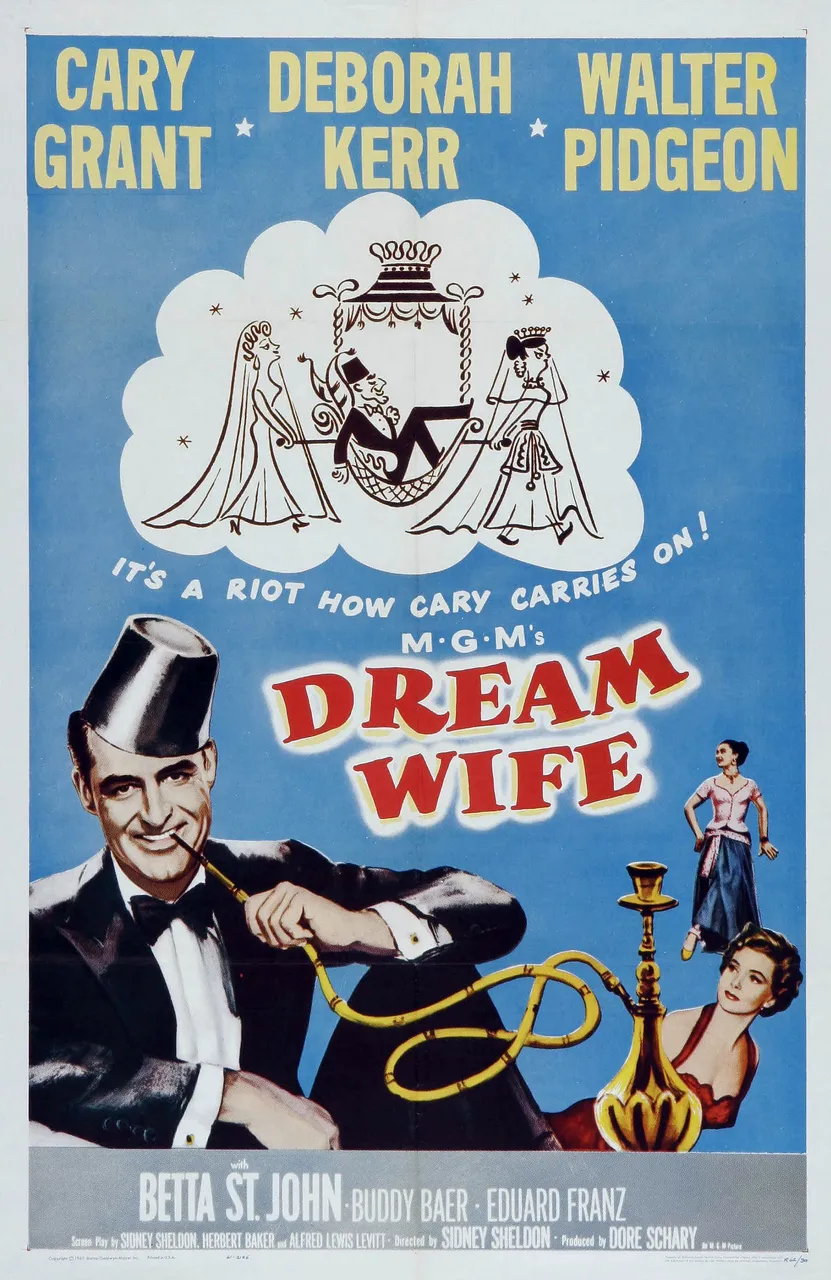
Dream Wife is a 1953 romantic comedy film starring Cary Grant and Deborah Kerr, directed by Sidney Sheldon and produced by Dore Schary, from a screenplay by Herbert Baker, Alfred Lewis Levitt, and Sidney Sheldon. The film's secondary stars included Walter Pidgeon and Betta St. John, with supporting performances by Eduard Franz, Buddy Baer, Richard Anderson, and Gloria Holden. The plot revolves around a business tycoon who decides to marry a Middle Eastern princess, whose customs dictate that the pair must live apart for several months before marrying. The film received an Oscar nomination for costume design by Herschel McCoy and Helen Rose. According to MGM records, the film earned $1,213,000 in the U.S. and Canada and $672,000 elsewhere, meaning it resulted in a loss of $456,000.
Plot
The plot of the 1953 film "Dream Wife" revolves around a business tycoon who decides to marry a Middle Eastern princess. However, their union is complicated by the princess's customs, which dictate that the pair must live apart for several months before marrying. Further complications arise when the tycoon's ex-fiancée is assigned to chaperone the pair. The film is a romantic comedy that explores the challenges and humorous situations that arise from this unconventional marriage arrangement. The movie features stars such as Cary Grant, Deborah Kerr, Walter Pidgeon, and Betta St. John.
Trailer
@taskmaster4450le/re-leothreads-2bbq5dyhi
Cast
- Cary Grant as Clemson Reade
- Deborah Kerr as Priscilla 'Effie' Effington
- Walter Pidgeon as Walter McBride
- Betta St. John as Tarji
- Eduard Franz as Khan of Bukistan
- Buddy Baer as Ahmed, the Royal Wrestler
- Les Tremayne as Mr. Bundy
- Donald Randolph as Hassan, the Prime Minister
Director: Sidney Sheldon
Distributor: Metro-Goldwyn-Mayer
Genre: Romance, Comedy
Release Date (Theaters): Jun 19, 1953
Release Date (Streaming): Jun 22, 2009
Theme
The theme of "Dream Wife" revolves around the challenges and humor associated with an unconventional marriage arrangement between a business tycoon and a Middle Eastern princess. It explores cultural differences, the complexities of relationships, and the comedic situations that arise from the clash of customs.
Reception
The film "Dream Wife" received mixed reviews and had a modest box office performance. It was nominated for an Oscar in the category of costume design. The reception of the film was influenced by its romantic comedy genre, the performances of the lead actors, and the cultural themes depicted in the storyline.
Settings
The settings in "Dream Wife" include both Western and Middle Eastern locations, reflecting the contrast between the characters' cultural backgrounds. The film portrays opulent palaces, elegant ballrooms, and other lavish settings that befit the romantic and comedic elements of the story.
Visual Styles and Techniques
The visual style of "Dream Wife" is characterized by the opulence of its settings, reflecting the grandeur associated with the romantic comedy genre. The film may have employed techniques such as vibrant cinematography, elaborate costumes, and set design to enhance the visual appeal and capture the cultural contrasts central to the storyline.
Trivia and Fun Facts
- "Dream Wife" features a notable cast, including Cary Grant, Deborah Kerr, Walter Pidgeon, and Betta St. John, who brought their star power to the romantic comedy genre.
- The film's portrayal of the clash between Western and Middle Eastern customs and traditions provides a lighthearted and comedic take on the challenges of intercultural relationships.
General:
Page by @iskafan